
Every great Christian novel or short story is, at some level, a biblical story in disguise. It may be set in contemporary Las Vegas or 19th century London or a fictional small town in the American South, but somewhere beneath the surface, a scriptural truth is doing the work.
This is not an accident. The Bible is not just a theological document. It is one of the richest collections of story, character, and conflict in all of human literature. Its themes are not religious curiosities; they are the deepest patterns of human experience. That is why they keep showing up in the best Christian fiction, and why they resonate so powerfully with readers who have never opened a Bible.
Here are ten biblical themes that appear consistently in the strongest Christian fiction, with examples of how authors have used them and why they work.
1. Redemption
If there is one word that defines Christian fiction as a genre, it is redemption. The idea that a person who has made a wreck of their life, who has sinned, failed, and hurt others, can still be restored, is the central promise of the gospel and the central engine of countless Christian stories.
Francine Rivers’s Redeeming Love, a retelling of the book of Hosea set during the California Gold Rush, is perhaps the most famous example. A man loves a woman who repeatedly returns to a life of prostitution. He takes her back every time. The theology is uncomfortable. The story is unforgettable. It is the best illustration available in contemporary Christian fiction of what Romans 5:8 actually means in human terms.
2. Grace
Grace is closely related to redemption but distinct: it is the unearned, undeserved gift that comes not because of what you have done but in spite of it. Christian fiction at its best does not let characters earn their happy endings. They receive something they did not work for, and the reader feels the force of that gift.
3. Forgiveness
Forgiveness is one of the hardest things a human being can be asked to do, and fiction is one of the best spaces to explore why. The best Christian novels do not present forgiveness as easy or instant. They show the cost of it, the resistance to it, and the slow, painful process of choosing it anyway. Karen Kingsbury’s entire Baxter Family series is built on the architecture of forgiveness within a complicated family.
4. Identity and Purpose
Who am I? Why am I here? These questions drive enormous amounts of Christian fiction. Characters who do not know their value, who have built their identity on the wrong things, or who are running from their calling form the foundation of countless stories. This theme speaks directly to the biblical conviction that each person is made in the image of God and called for a specific purpose.
C.L. Holden’s Running from Destiny takes its title directly from this theme. The very idea of running from destiny is a running from calling, a resistance to what God has marked for your life. It is a theme readers recognize immediately because most of us have lived it. You can explore this book at Stories by CL Holden.
5. Doubt and Faith
The most authentic Christian fiction does not portray faith as the absence of doubt. It portrays faith as the choice to continue believing in the presence of doubt. This tension is one of the richest veins in Christian storytelling. Characters who wrestle with God, who demand answers that do not come, who sit in the silence and wait, are more compelling and more spiritually instructive than characters who never waver.
6. Sacrifice
From Abraham and Isaac to the cross itself, the theme of sacrifice runs through the entire biblical narrative. Christian fiction returns to it again and again, in characters who give up something they value for someone they love, or for a principle that costs them everything. The best sacrificial story arcs are not sentimental. They are costly, and the reader feels the weight of that cost.
7. Second Chances
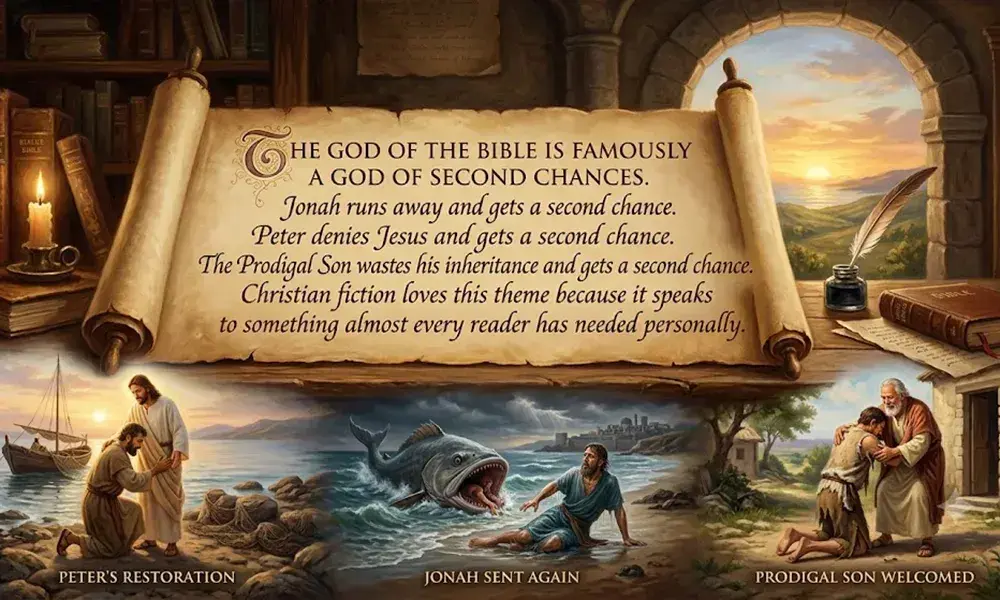
The God of the Bible is famously a God of second chances. Jonah runs away and gets a second chance. Peter denies Jesus and gets a second chance. The prodigal son wastes his inheritance and gets a second chance. Christian fiction loves this theme because it speaks to something almost every reader has needed personally.
8. Community and the Body of Christ
Much secular fiction focuses on the individual hero. Christian fiction, at its best, tells stories of community, of the way believers need each other, carry each other, and sometimes fail each other in ways that require grace to heal. The church, in all its messiness and beauty, is one of the most interesting settings in all of Christian fiction.
9. Spiritual Warfare
Frank Peretti’s This Present Darkness brought the concept of spiritual warfare into popular Christian fiction and created an entirely new subgenre. The idea that there is a battle happening at a level humans cannot see, that prayer has real consequences in an unseen realm, is a distinctly Christian conviction that translates into extraordinary narrative tension when handled skillfully.
10. Hope
Perhaps the simplest and most essential biblical theme of all: hope. The conviction that things are not as they will always be, that suffering does not have the final word, that dawn follows the longest night. This is the thread that holds all of Christian fiction together. Whatever else a story contains, if it ends with hope, it is doing the work of the gospel. For a look at how these themes show up in contemporary short fiction, visit Stories by CL Holden and explore the books and blog resources available there.
Why These Themes Still Work
The reason biblical themes never go out of style in fiction is simple: they are not just theological propositions. They are descriptions of the deepest patterns of human experience. Every person alive has needed redemption in some form. Every person has experienced the devastation of unforgiveness and the liberation of letting it go. Every person has doubted and hoped and sacrificed and wondered what they were made for.
When a Christian author takes one of these themes and roots it in a specific, concrete story with specific, concrete characters, the abstract becomes personal. The reader sees their own experience reflected and possibly transformed.
For further exploration of how biblical themes show up in Christian fiction, the Bible Gateway is an excellent resource for looking up the original scriptural passages that inspire these themes, allowing readers to move fluidly between story and Scripture.