
Most people think of reading as entertainment. And it is. But for millions of people around the world, a book has been more than a way to pass time. It has been a bridge back from grief. A companion in loneliness. A mirror that showed them what they needed to see about themselves when no one else could.
Faith-based fiction, in particular, carries a kind of healing power that other genres rarely match. These stories deal honestly with human pain while anchoring that pain in something larger than the reader’s own experience. They say, in effect: you are not the first person to feel this, and you will not be the last, and there is still hope.
This article looks at why faith-based fiction helps people heal, what the research says, and how real readers have found their way through loss, doubt, and crisis with a book in their hands.
What Is Bibliotherapy and How Does It Work?
Bibliotherapy is the practice of using literature as a therapeutic tool. The concept has been recognized by mental health professionals for decades. According to the American Library Association, bibliotherapy can be used to help individuals deal with emotional difficulties, mental health challenges, and personal crises by connecting them with stories that reflect or illuminate their own experiences.
The mechanism is straightforward: when we read a story about a character who faces a situation similar to ours, we feel less alone. We gain language for experiences we could not name. We watch someone navigate pain and come out on the other side, and that gives us permission to believe we might too.
For faith-based fiction, this process is deepened by the spiritual dimension of the stories. A reader struggling with the feeling that God has abandoned her might pick up a novel where the protagonist wrestles with exactly that question, and find in the resolution not just a satisfying ending but a theological lifeline.
The Science Behind Story and Emotional Healing
Neuroscience supports what readers have known intuitively for centuries. A study published in the journal Trends in Cognitive Sciences found that reading narrative fiction activates the same neural networks involved in real-life social cognition. When we follow a character through an emotional experience, our brains process it similarly to a lived experience. We develop empathy, expand our emotional vocabulary, and rehearse responses to situations we have not yet encountered.
This means that reading a novel about grief can help prepare us for loss. Reading a story about forgiveness can soften our own resistance to forgiving. Reading about a character who finds her way back to faith can create a neural pathway where, before, there was only a wall.
How Christian Fiction Specifically Supports Healing
Not all bibliotherapy is equal. Faith-based fiction offers several specific qualities that make it particularly effective for emotional and spiritual healing.
It Validates Spiritual Struggle
One of the hardest things about walking through grief, doubt, or crisis as a person of faith is the feeling that you should not be struggling. If you really believed, you would not be this afraid. If you really trusted God, you would not be this angry.
Christian fiction pushes back on that lie. The best faith-based stories feature characters who doubt, wrestle, fail, and cry out in the darkness. They are not spiritual supermen. They are people, and their faith is tested in the fire. When a reader sees that kind of honesty in a story, she is given permission to be honest with herself.
It Offers a Framework for Suffering
Secular fiction can acknowledge pain without explaining it. Christian fiction can go a step further, offering not answers exactly, but a framework. The story might not tell you why your marriage fell apart or why your child is sick, but it can place that suffering inside a larger narrative where suffering is not the final word.
This is what theologians call a theology of the cross: the conviction that God is present not only in triumph but in the middle of the pain. Christian fiction often embodies this conviction better than a sermon can, because stories show rather than tell.
It Creates Community Across Time
When a reader picks up a Christian short story collection or novel, she enters a conversation that has been going on for centuries. From the parables of Jesus to the allegories of John Bunyan to the contemporary testimonies of authors like C.L. Holden, Christian storytelling is a living tradition. There is comfort in knowing you are not isolated in your experience, but connected to a great cloud of readers and writers who have faced similar struggles.
Real Reader Stories: When Fiction Became a Lifeline
Anecdotal evidence is not the same as clinical research, but it carries its own kind of truth. Across reading communities, forums, and book groups, Christian fiction readers consistently share versions of the same story.
| “I read three Christian novels while my husband was receiving chemotherapy. I could not pray. I could not read the Bible. But I could follow a character through her own dark night and come out the other side with her. Those books kept me sane.” – A reader from an online Christian book club |
| “After my divorce, I thought God was done with me. I read a story about second chances and redemption, and something in me broke open in a good way. I went to church the following Sunday for the first time in two years.” – Reader testimonial shared in a faith-based reading group |
Stories like these are not rare. They are, in fact, the reason many Christian authors write. Authors like Karen Kingsbury have spoken publicly about readers who credit her novels with saving their marriages, restoring their faith, or pulling them back from the edge of despair.
Practical Ways to Use Faith-Based Fiction for Healing
If you or someone you love is going through a difficult season, here are some ways to intentionally use Christian fiction as part of the healing process.
• Read with intention: Choose books that touch on the specific area where you are hurting. If you are grieving, look for stories about loss and restoration. If you are doubting, look for characters whose faith is tested.
• Journal after reading: Write down one thing the story made you feel, one question it raised, and one thing you want to carry forward.
• Read in community: A book club or small group reading the same story creates space for shared processing and conversation.
• Pair reading with prayer: Let a character’s prayer in a novel become a template for your own.
• Share the story: Give a book to someone else who is struggling. A story can open a conversation that a direct conversation cannot.
Where to Start
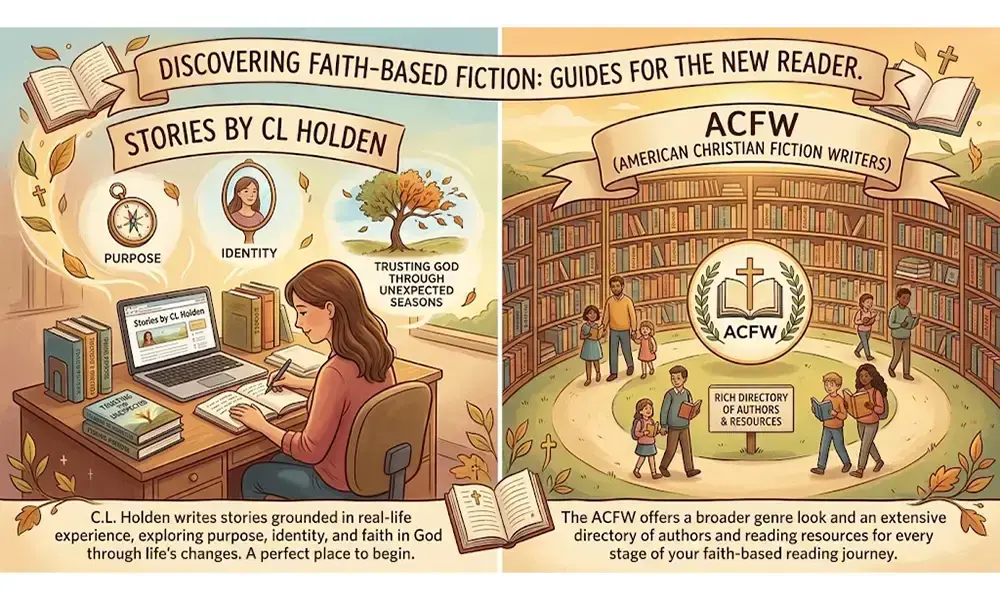
If you are new to faith-based fiction and looking for a place to begin, the blog at Stories by CL Holden is a great resource. C.L. Holden writes stories grounded in real-life experience, including themes of purpose, identity, and trusting God through unexpected seasons of life.
For a broader look at the genre, the ACFW (American Christian Fiction Writers) maintains a rich directory of authors and resources for readers at every stage of their faith-based reading journey.
Final Thoughts
Stories heal. It is one of the oldest truths we know. And for readers who carry a faith alongside their pain, Christian fiction offers something especially rare: a story that takes your struggle seriously and refuses to let it have the last word.
If you are in a hard season right now, pick up a book. Not to escape, but to find your way through. The right story might be exactly what you need.