The question comes up in nearly every book club, church reading group, and library resource guide: what exactly is the difference between Christian fiction and the secular novels that line the mainstream shelves?
It sounds like a simple question, but the answer is more nuanced than most people expect. Both categories include stories about love, betrayal, courage, grief, and redemption. Both include brilliant writing and mediocre writing. Both can leave a reader changed. So what, precisely, sets them apart?
The fundamental Difference: Worldview
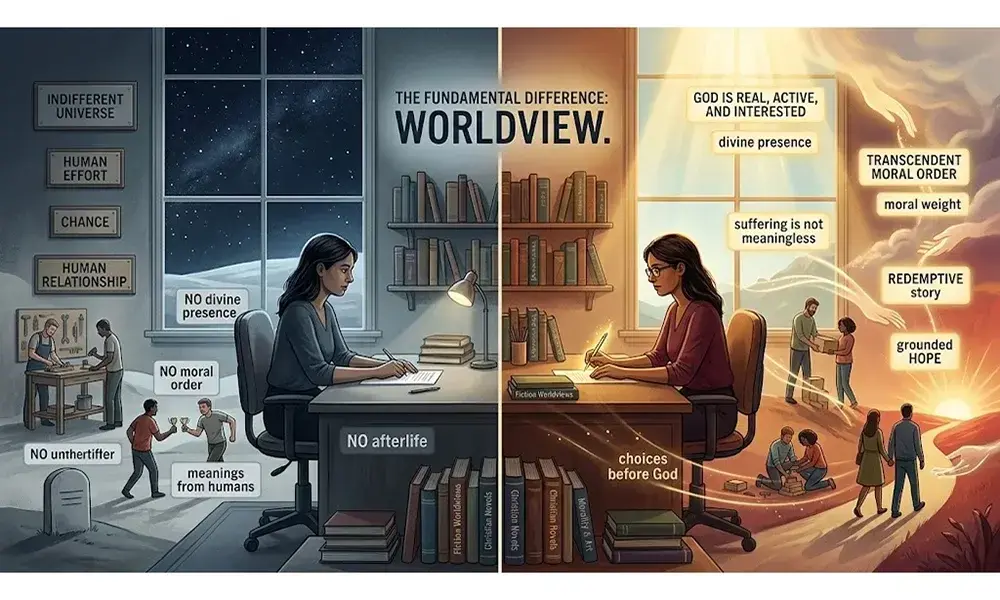
The most fundamental difference between Christian and secular fiction is not content level or language choices. It is worldview. A worldview is the underlying set of assumptions a story makes about reality, morality, purpose, and human nature.
Secular fiction, at its broadest, operates from a worldview in which the universe is essentially neutral or indifferent. Characters may find meaning, love, or purpose, but those things arise from human effort, relationship, or luck. There is no assumed divine presence shaping events, no transcendent moral order, no afterlife that gives weight to present choices.
Christian fiction operates from a worldview in which God is real, active, and interested in human lives. The story may not say this explicitly on every page, but it is assumed. Characters’ choices have moral weight because they are made before a God who sees and cares. Suffering is not meaningless because it exists within a larger story of redemption. Hope is not naive because it is grounded in something beyond human optimism.
Content Differences: What to Expect
Worldview shapes content, so the two categories do tend to differ in predictable ways.
Language
Most Christian fiction avoids profanity, or uses it sparingly and with clear narrative purpose. This is not about being unrealistic; it is about maintaining a tone that reflects the genre’s values. Secular fiction has no such convention and may range from clean to explicit depending on the author and genre.
Sexuality
Christian fiction typically keeps romantic and sexual content within the boundaries of biblical standards. Couples in Christian romance novels fall in love and may share a kiss, but explicit scenes are generally absent. Secular fiction, particularly in the romance genre, often includes explicit content as a standard feature.
Violence
Both categories include violence, especially in thriller and suspense subgenres. Christian fiction tends to avoid gratuitous gore, though it does not shy away from depicting the consequences of violence or the reality of evil. Secular thrillers may be considerably more graphic.
Resolution
This is one of the most noticed differences among readers. Christian fiction tends toward hopeful resolutions. This does not always mean a happy ending in the conventional sense; characters can die, relationships can end, and circumstances can remain hard. But even in darkness, there is usually a note of grace or meaning that secular fiction is under no obligation to provide.
Theme Differences
Both types of fiction explore universal human themes, but they approach them from different angles.
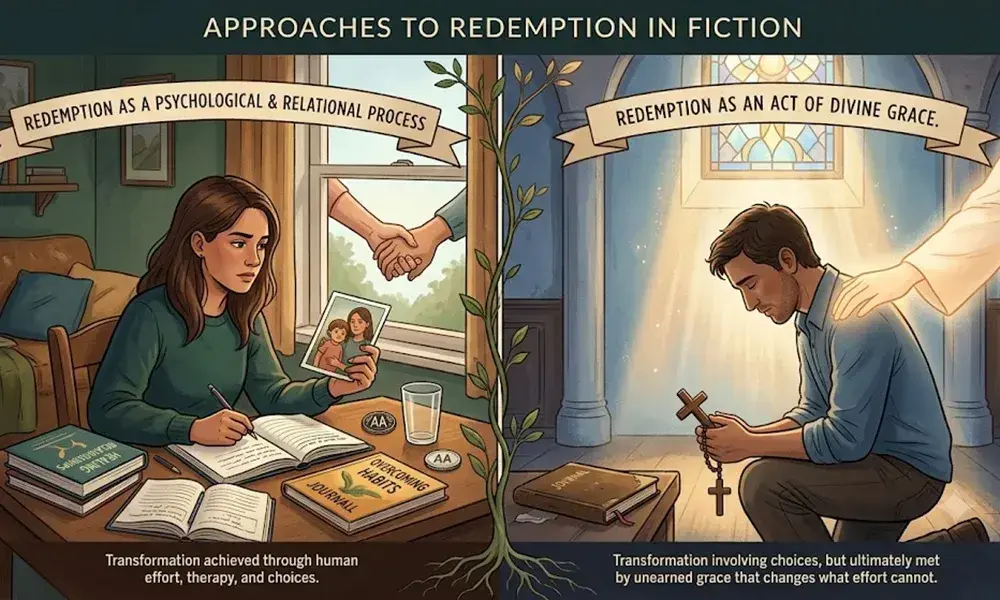
Secular fiction may explore redemption as a psychological or relational process: a character stops drinking because her daughter needs her, or a man forgives his father after years of therapy. The transformation is real and moving, but it is achieved through human agency.
Christian fiction explores redemption as something that ultimately comes from outside the human self. A character’s transformation may involve therapy, relationships, and hard choices, but at some level, it is also grace. Something unearned and undeserved meets her in the middle of her mess and changes what human effort alone could not.
This theological distinction shapes everything from plot structure to character motivation to the emotional register of the ending.
Are There Overlapping Books?
Yes, and this is where the boundaries get genuinely interesting. Some books written by Christian authors are not typically classified as Christian fiction because the faith element is not central to the plot. And some books written by secular authors deal so honestly with themes of grace, sacrifice, and redemption that readers of faith claim them as their own.
C.S. Lewis’s fiction is a classic example of work that straddles this line. The Narnia books are deeply Christian in their symbolism, yet they are shelved in mainstream children’s fiction and read enthusiastically by readers of every background. Dostoevsky’s novels, written by a deeply Christian man, are standard secular literary fiction. As Wikipedia notes on Christian literature, the presence of a Christian author does not automatically make a work Christian fiction.
Which One Is Better?
This is the wrong question, and most thoughtful readers on both sides know it. The better question is: which is right for you, right now, in this season of your life?
If you are looking for a story that will validate your faith, speak to your spiritual questions, and offer you hope rooted in something transcendent, Christian fiction is built for that purpose. If you want to engage with a wider range of human experience, including perspectives that challenge your worldview, secular fiction has a great deal to offer.
Many Christian readers, including many pastors and theologians, read both. They bring their faith lens to every story, finding threads of grace even where the author did not intend them. They also appreciate that Christian fiction gives them stories where those threads are woven in on purpose.
A Note on Quality
It is worth being honest here: both Christian and secular fiction include brilliant work and mediocre work. For many years, critics fairly noted that some Christian fiction sacrificed literary quality for doctrinal correctness, producing stories that were theologically sound but narratively thin.
That has changed significantly. Authors like Francine Rivers, Marilynne Robinson (whose novel Gilead won the Pulitzer Prize), and Toni Morrison (who wrote with deep Christian themes) demonstrate that faith-informed fiction can achieve the highest literary standards. The current generation of Christian fiction authors is, on the whole, more skilled, more willing to embrace complexity, and more committed to craft than earlier generations.
For readers looking for a starting point that balances literary quality with strong faith content, the Christy Award is an annual recognition for excellence in Christian fiction that highlights the best of what the genre has to offer.
Final Thoughts
The difference between Christian fiction and secular fiction is real, but it is not a wall. It is a lens. Christian fiction sees the same human stories through a lens of faith, and for readers who share that faith, that lens makes all the difference. If you are curious where to begin, start with the blog at Stories by CL Holden, where you will find thoughtful perspectives on Christian fiction and access to books that demonstrate what this genre can do at its best.